How to deliver better board and SLT papers more quickly
How often do papers come together in a scramble just before they must be submitted for review? Perhaps you …
… left it to the last because you assumed you only needed to tweak a few details in last month’s paper, only to realise that this particular board presentation required more?
… received an ambiguous briefing and delayed your preparation because you frankly didn’t know where to begin?
… waited for quite some time to receive stakeholder feedback, which turned out to be substantive and required you to burn the midnight oil to finish?
These are just three collaborative challenges that limit not only the speed of preparation, but also the quality of insights they contain.
Why?
Delivering papers that are both insightful and useful leans more heavily on collaboration than many realise.
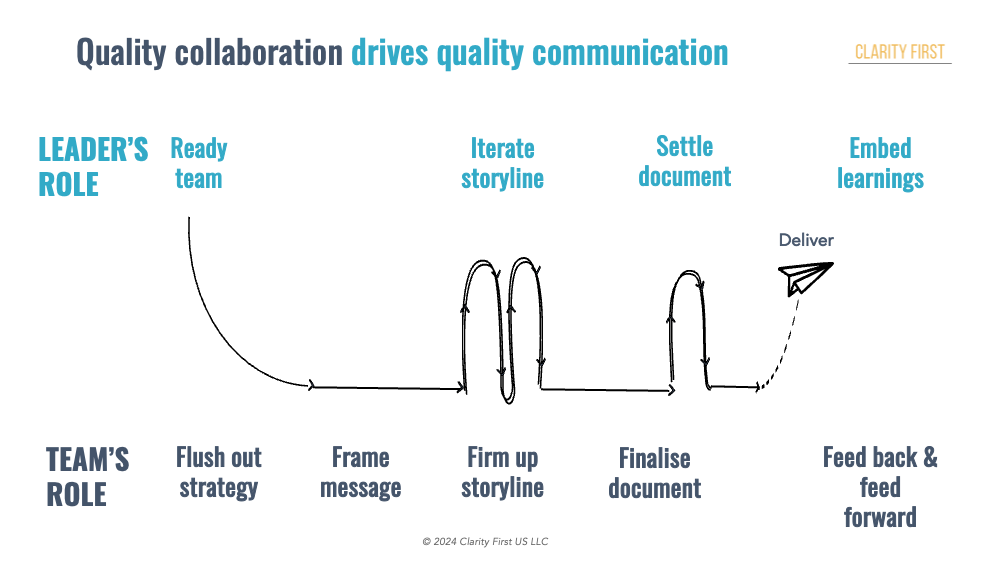
In my experience, teams that prepare their papers with minimal midnight oil result from leaders driving the process that:
- Readies their teams early so they appreciate why the paper is needed and what it needs to achieve.
- Iterates the messaging around a highly-structured one-pager to ensure everyone can contribute quickly and substantively to what really needs to be said.
- Settles the document to check that it reflects the agreed messaging before it is delivered.
- Embeds the learnings from preparing and delivering the communication to ensure the team can grow together.
Here is how I visualise a process that consistently elevates the quality of thinking in my client’s papers while slashing the time they take to prepare them.
I hope that helps, more next week.
Davina.
PS – This is the framework that underpins both of my new books, Elevate and Engage. I’ll be sharing more from the book in the coming months as we finalise each one.
PPS – You might also enjoy my conversation with Will Bachman on the Unleashed podcast where I offer more board paper writing tips, such as my RISE framework. You can find that episode here.
WANT TO LISTEN?
- Risk Management = Change Management
- Richard Medcalf – Making Time for Strategy
- Baking Learning & Growth into BAU
- Helping Leaders ‘shift testing left’ to derisk projects
- A Case Study in Digitial Transformation
- How to help a senior leader come back from a misstep
- How to hit the ground running in a big new role
- How to communicate during great change
- How to turbo charge your transformation
RELATED POSTS

The worst answer isn’t ‘no’

Shorter and clearer aren’t the same thing

From ‘let’s discuss later’ to approved within the hour

Why your best ideas get flagged for later

How much can you say in 30 seconds?

The art of less
Your team worked hard on that doc. But does it tell the decision-maker what they actually need? Here’s how to strip it back to what matters.